Types of Camera Shots: A Complete Guide for Better Photography and Filmmaking

Photography and filmmaking are some of the best careers right now. However, you need to learn the types of camera shots to make sure the results are worth the money. This is because every shot tells a story and shows emotions to make sure you get the attention of your viewers. The right camera shot will make a huge difference to your photos, YouTube videos, or short films, whatever you want to create. This article includes different types of camera shots and how you can choose the best one according to your content style.
Part 1: What Are Camera Shots?
A camera shot is how the subject is framed in your camera's view. It will decide how much of a person or something appears in the frame. Choosing the right camera shot will help you guide the viewer's attention in specific directions. Camera shots, camera movements, and camera angles work together, but all of them have different purposes.
What Is a Camera Shot?
A camera shot is the amount of the subject and surrounding area captured in a single frame. It tells viewers what to focus on and helps shape the story. A shot may show an entire landscape, a person's full body, or a small detail like a face or hands. Different shots create different effects. For example, a wide shot introduces the setting, while a close-up highlights emotions or important details. Choosing the right framing or camera angle shot types makes scenes more engaging and helps communicate your message clearly.
Camera Shots vs. Camera Angles vs. Camera Movements
Many beginners confuse these three terms, but they each describe something different, like different types of film shots.
- Camera shots show how much of the subject appears in the frame, such as wide, medium, or close-up shots.
- Camera angles describe where the camera is positioned in relation to the subject. A typical camera angles list includes eye-level, high-angle, low-angle, bird's-eye view, and an angled shot (Dutch angle). If you're wondering what camera angles are, they simply refer to the camera's viewing position.
- Camera movements explain how the camera moves during recording, such as panning, tilting, zooming, or tracking.
Camera Shots vs. Camera Angles vs. Camera Movements
| Feature | Camera Shots | Camera Angles | Camera Movements |
|---|---|---|---|
| What it controls | Subject framing | Camera position | Camera motion |
| Main purpose | Show how much of the scene is visible | Change the viewer's perspective | Add movement and energy |
| Common examples | Wide shot, medium shot, close-up | Eye-level, high-angle, low-angle, angled shot |
Pan, tilt, zoom, dolly |
Create Multiple Camera Shots More Efficiently with OBSBOT Talent 2 All-In-One Multi-Cam Live Streaming Studio
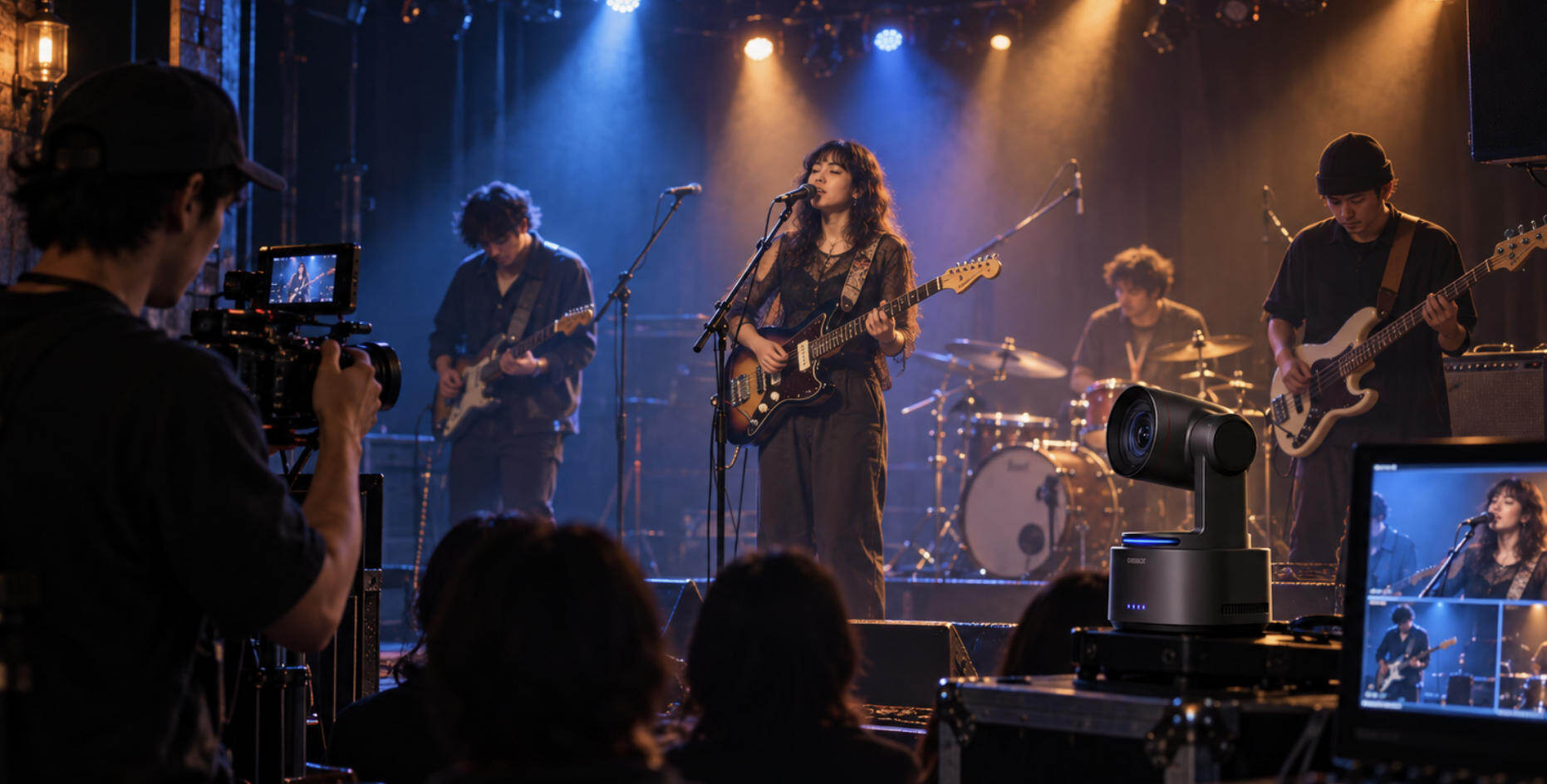
Knowing different camera shots is one thing, but switching between them smoothly during a live production is another. When covering interviews, sports events, church services, conferences, or live shopping sessions, creators often need to transition between wide, medium, close-up, and multi-camera views in real time. OBSBOT Talent 2 is an all-in-one multi-cam live production studio that consists of an encoder, switcher, recorder, monitor, and controller in one compact device—capable of pushing the finished show to up to four platforms at once in true 4K.
Key Features:
- Supports 16 Video Inputs: Manage 4 HDMI inputs, 2 USB inputs, and up to 10 network sources (NDI, SRT, RTSP, and RTMP) to switch between wide shots, medium shots, and multiple camera angles.
- All-in-One Live Production Studio: Has an encoder, switcher, monitor, recorder, and streaming hub to manage multiple camera shots in real time while reducing equipment.
- Video Production Tools: Built-in PIP, Chroma Key, ISO Recording, Instant Replay, Video Cropping, Lower Thirds, and Audio Mixer to produce live streams while presenting different camera shots
- Vertical & Horizontal Streaming: Switch between landscape (16:9) and portrait (9:16) layouts in true 4K to create camera shots that fit different platforms, including YouTube, TikTok, Instagram, and Facebook Live.
- Multi-Camera Switching: Cut between shots on the fly with smart auto-switch modes (sequential, random, or audio-followed), or take direct control from the touchscreen, any web browser, a Stream Deck, or OSC/API for smoother multi-camera productions.
Part 2: The Most Common Types of Camera Shots
All camera shots serve different storytelling purposes. Some show the entire environment, while others highlight emotions or important details. Learning all kinds of shots helps you decide which one fits each scene.
Close-Ups and Medium Close-Ups
When the goal is to highlight emotion or fine detail, a close-up (CU) fills the frame with a person's face or an important object. A medium close-up (MCU) frames the subject from the chest or shoulders up, balancing facial expressions with a small amount of surrounding context. Because little background is visible, these shots create a stronger emotional connection and emphasize important moments.
Best for:
- Emotional scenes
- Interviews
- Product videos
- Character reactions
Medium Shots
Framing the subject from approximately the waist up, the medium shot in film creates a natural balance between the person and the surrounding environment. It is one of the most widely used shots in films, TV shows, and online videos because it captures facial expressions while still providing contextual background.
Best for:
- Conversations
- Tutorials
- News broadcasts
- Presentations
Long Shots
To ensure the focus on both the subject and the environment, filmmakers often use a long camera shot. This framing captures the subject's full body along with a significant portion of the surroundings, helping viewers understand the location and how characters interact with it.
Best for:
- Action sequences
- Sports events
- Dance performances
- Character introductions
Extreme Long Shots
Sometimes the environment is more important than the subject itself. In these situations, an extreme long shot (ELS) places the subject far from the camera so they appear small within a vast landscape. This framing emphasizes scale, isolation, or the grandeur of a location.
Best for:
- Opening scenes
- Landscape photography
- Travel films
- Nature documentaries
Over-the-Shoulder (OTS)
An over-the-shoulder shot is filmed from behind one person's shoulder while keeping another person in focus. It helps viewers follow conversations naturally and understand the relationship between characters by placing them in the middle of the interaction.
Best for:
- Dialogue scenes
- Interviews
- Video podcasts
- Two-person conversations
Point-of-View (POV)
Immersing the audience in a character's experience can make a scene far more engaging. A point-of-view (POV) shot recreates what the character sees, allowing viewers to experience the action through their eyes and feel directly involved.
Best for:
- Action scenes
- Adventure films
- Sports videos
- First-person storytelling
Perspective Shots
The same subject can appear powerful, vulnerable, or distant simply by changing how it is viewed. That visual effect comes from using a perspective shot, where the camera's position influences the audience's interpretation without altering the action itself.
Best for:
- Dramatic storytelling
- Creative filmmaking
- Character introductions
- Emotional moments
Dolly Shots
Physical camera movement can add depth and energy that a simple zoom cannot achieve. When the camera travels toward, away from, or alongside the subject, the result is a dolly shot, producing smooth, cinematic motion.
Best for:
- Following moving subjects
- Revealing locations
- Building suspense
- Smooth scene transitions
These are some of the different types of camera shots in film used by directors around the world. Choosing the right shot depends on your story, subject, and creative goal.
Part 3: FAQs About Types of Camera Shots
1. What equipment is needed to shoot various types of cinematic shots?
A camera or modern smartphone can produce excellent results. A sturdy tripod helps keep shots stable, while a gimbal creates smooth-moving footage. Different lenses, such as wide-angle or telephoto lenses, allow you to capture different framing styles.
2. How do different camera angles affect the mood of a scene?
Eye-level angles feel natural and balanced. High-angle shots can make a person seem weak or lonely, while low-angle shots often make them appear powerful or confident. A Dutch or angled shot creates tension, confusion, or suspense.
3. How do filmmakers choose the right camera shot for a scene?
Filmmakers first think about the purpose of the scene. If they want to introduce a location, they often use a wide shot. If they want viewers to notice emotions, they may choose a close-up. Action scenes often comprise wide, medium, and close-up shots to keep the audience engaged.
4. Can beginners learn camera shots using only a smartphone?
Yes, many beginner filmmakers start with smartphones because today's phone cameras offer high-quality video recording. By practicing framing, lighting, and composition, beginners can learn nearly every basic camera shot.
5. Why do movies use several camera shots in one scene instead of only one?
Using multiple camera shots makes scenes more interesting and easier to follow. A wide shot establishes the location, medium shots show conversations, and close-ups capture emotional reactions. Editors join these shots to create a smooth story.
Conclusion
Understanding the types of camera shots gives you a stronger foundation for creating better photos and videos. Every shot serves a different purpose, from showing a large environment to capturing a person's emotions or highlighting small details. Practice using different framing styles, experiment with new ideas, and pay attention to how professionals build scenes. With regular practice and the right techniques, you will develop the confidence to create videos and photographs that are more engaging, visually balanced, and effective at telling your story.