Ergonomic Desk Setup: How to Create a Comfortable Home Workspace
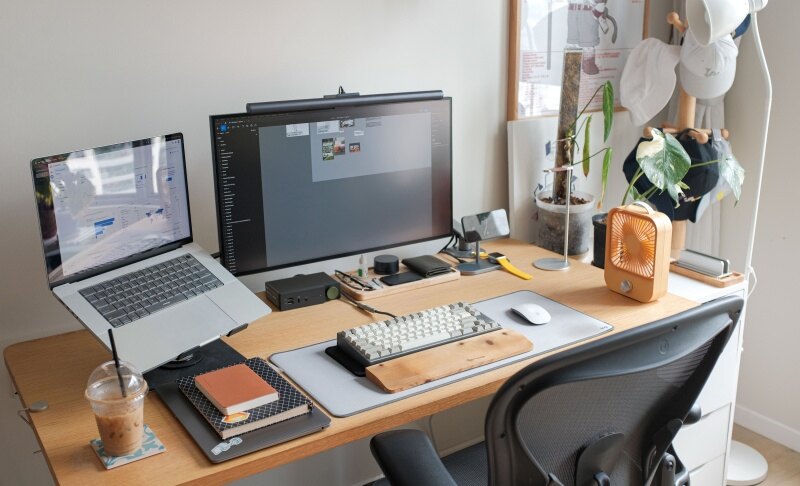
If your neck, wrists, or lower back ache by mid-afternoon, the problem is almost always your desk, not your body. An ergonomic desk setup means positioning your chair, desk, monitor, keyboard, and mouse so your body stays neutral and relaxed for hours at a time. Below is a quick self-check, followed by exact steps to fix each part of your workstation today.
Ergonomic Desk Setup Quick Checklist
Run through this list before changing anything. It tells you exactly where your current work station set up is falling short.
- Feet flat on the floor or a footrest
- Knees and hips comfortably bent, thighs roughly parallel to the floor
- Back supported, lumbar curve maintained
- Shoulders relaxed, not raised or hunched
- Elbows close to the body, near a 90° angle
- Wrists straight, not bent up or down
- Monitor centered directly in front of you
- Top of screen at or slightly below eye level
- Screen 20–26 inches away
- Keyboard and mouse close together
- Lighting doesn't cause screen glare
- Frequently used items within reach, no twisting
- Position changes every hour or so
If several boxes are unchecked, the sections below walk you through the fix.
Step 1 – Set Up Your Chair First
Your chair is the foundation of a correct ergonomic desk setup — get it wrong, and nothing above it will feel right.
Seat height and depth: Adjust the seat so your thighs are parallel to the floor, knees at roughly 90°, and feet flat on the ground. If the chair won't go low enough, add a footrest. Sit with your hips pushed all the way back into the seat, back against the backrest — not perched on the edge.
Lumbar support: Adjust the backrest or add a lumbar cushion so it fills the curve of your lower back. A slight recline (100–110°) reduces spinal pressure during long sitting stretches; sit more upright for focused tasks like typing.
Armrests: Set them so your shoulders stay relaxed and your elbows rest naturally without shrugging up.
Step 2 – Adjust Desk and Elbow Height
Desk height is where most computer ergonomic setup problems start. Your elbows should bend at roughly 90°, with forearms level with (or angled slightly down toward) the desk surface. As a reference point, ANSI guidelines put sitting desk height around 27 inches and standing desk height around 43.5 inches — but always fine-tune based on your own height.
If your desk isn't adjustable, add a keyboard tray, or raise your chair and compensate with a footrest.
Step 3 – Position Your Monitor Correctly
Monitor placement is the single biggest factor in a correct ergonomic desk setup, since it determines how much you crane your neck.
- Keep the screen 20–26 inches away — about an arm's length.
- Place the top of the screen at or slightly below eye level, with the center tilted about 15–20° downward.
For an ergonomic desk setup two monitors version: place both screens at the same height and distance, angled slightly inward so you can shift your eyes rather than turning your whole neck between them. For laptop-only setups, a laptop stand or riser paired with an external keyboard and mouse turns it into a proper desktop-style ergonomic office desk setup instead of forcing you to hunch over a low screen.
Bonus Tip: If your setup includes video calls, your webcam position matters just as much as your monitor. A camera placed too low — like most built-in laptop cams — forces the same downward neck angle you're trying to avoid, and it usually shows you off at an unflattering angle too.
This is where mounting an external webcam like the OBSBOT Tiny 3 Lite on top of your monitor makes a real difference. It sits right at eye level, so you keep your neck neutral instead of hunching toward a laptop screen. It also comes with AI-powered auto-framing and tracking, which means the camera automatically keeps you centered and in focus even if you lean back, stretch, or shift position — so you don't have to freeze in one spot just to look good on camera. For anyone doing back-to-back video calls, that's one less physical constraint stacked on top of an already long day at the desk.
It's a small addition, but it pairs naturally with the rest of an ergonomic desk setup: correct posture for your body, plus a camera that doesn't force you to compromise it.
Step 4 – Position Keyboard and Mouse
Keep wrists straight and neutral while typing — not bent up, down, or sideways. Elbows should stay close to your body at roughly 90°, with the keyboard and mouse at the same height and placed close together so you're not reaching. If wrist strain persists, a split or ergonomic keyboard and a vertical mouse can help, though positioning matters more than the hardware itself.
Step 5 – Fine-Tune Lighting and Surroundings
| Issue | Fix |
|---|---|
| Screen glare | Position monitor perpendicular to windows |
| Dim lighting | Add adjustable task lighting, prioritize natural light |
| Cramped legroom | Clear clutter from under the desk |
A clean ergonomic desk layout isn't just about the chair and screen — it's also about giving your legs and feet room to move.
Common Ergonomic Desk Setup Mistakes to Avoid
- Monitor too high or too low — forces constant neck tilting
- Chair too far from the desk — pulls shoulders forward
- No lumbar support — collapses the lower back over time
- Mouse too far from keyboard — causes repeated overreaching
- Working straight off a laptop — the most common cause of neck strain in any ergonomic workstation setup
- Sitting for hours without moving — undoes even a perfect setup
FAQs About Ergonomic Desk Setup
1. Should you add a standing desk to your ergonomic setup?
Yes, but it complements your setup rather than replacing it — the same chair, monitor, and keyboard rules still apply when standing. Alternate sitting and standing every 30–60 minutes, keep elbows at 90° while standing, and use an anti-fatigue mat. One helpful habit: leave the desk raised overnight so you start the day standing, which encourages more frequent position changes.
2. How much does an ergonomic desk setup cost?
It can cost nothing. Repositioning your existing chair, using books as a monitor riser, and adjusting screen distance are free. Adjustable desks and ergonomic chairs are optional upgrades, not requirements.
3. How often should you take breaks from sitting?
Every 45–60 minutes. Movement matters even with a technically perfect setup, since no fixed position is ideal for hours on end.
4. What's the biggest mistake people make with home desk ergonomics?
Working directly off a laptop without raising the screen to eye level — it's the single most common cause of neck and shoulder pain in home offices.
Conclusion
A genuinely ergonomic desk setup comes down to five things: a properly adjusted chair, correct desk height, a monitor at eye level, a keyboard and mouse within easy reach, and glare-free lighting. You don't need to overhaul everything at once — work through the checklist and steps above one at a time, and most people notice less strain within days.