The Best Game Streaming Setup: Beginner to Pro
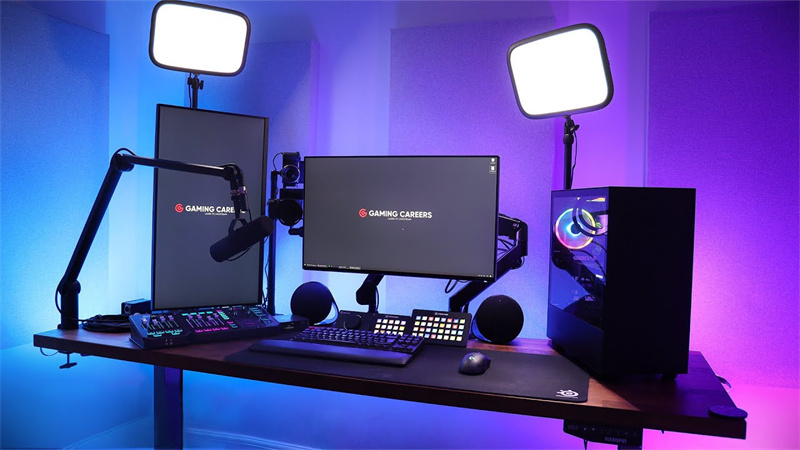
A complete game streaming setup starts with a gaming device, stable internet, clear audio, and a way to broadcast. Start with the equipment needed for a reliable first stream, then add production gear only when it solves a clear problem.
PC gamers can use OBS Studio to capture gameplay, audio, facecam, and overlays from one computer. PS5 and Xbox players can stream directly from the console or add a capture card and PC when they need more control.
| Setup Path | Core Equipment | Best For |
|---|---|---|
| PC Game Streaming | Gaming PC, OBS Studio, microphone, stable internet | PC gamers who want control of gameplay, scenes, audio, and overlays. |
| Direct Console Streaming | PS5 or Xbox, linked platform account, headset or microphone | Console players who want the fastest route to a first stream. |
| Console + PC Streaming | Console, capture card, PC with OBS, microphone | Creators who need facecam layouts, alerts, overlays, or local recording. |
| Dual-PC Streaming | Gaming PC, streaming PC, capture card, OBS | Demanding games that one PC cannot game and stream reliably at the same time. |
What Equipment Do You Need for Game Streaming?
Build your first setup around stable gameplay, reliable upload speed, and clear voice. These are the essentials. A capture card, second display, webcam, lighting, and audio mixer are useful when your stream needs more production control.
1. Gaming PC or Console
Choose the device you already play on first. A gaming PC can run the game and OBS in one workflow. A PS5 or Xbox can broadcast directly to supported platforms for a simpler first stream.
- For PC streaming: Look for a modern CPU, dedicated GPU, at least 16GB of RAM, and enough SSD space for games and local recordings.
- For console streaming: Start with direct console broadcasting if you only need gameplay and voice commentary.
- For demanding games: Consider dual-PC streaming only after testing shows that one PC cannot run the game and encode a stable stream together.
2. Stable Internet Connection
Choose stable upload speed over the highest advertised download speed. A wired Ethernet connection is usually more reliable than Wi-Fi for live streaming.
- Test consistently: Run upload-speed tests at the time you normally plan to go live, not only once.
- Leave headroom: Keep your stream bitrate below about 70% of your consistent upload result.
- For Twitch: Aim for at least 10 Mbps stable upload when streaming 1080p60 at 6,000 Kbps.
- For YouTube: Aim for 15 Mbps or more when streaming 1080p60 at 6,000-12,000 Kbps.
3. Microphone or Gaming Headset
Clear voice should come before advanced production gear. Viewers can accept a simple layout, but distant or noisy commentary makes a stream difficult to follow.
- For a first stream: Use the headset microphone you already own.
- For clearer commentary: Upgrade to a USB microphone when headset audio sounds distant, noisy, or inconsistent.
- For one person: A cardioid microphone is often a practical choice because it focuses on sound in front of the microphone.
4. OBS Studio or a Console Broadcast Tool
Use OBS when you need control over the production. It combines gameplay, microphone audio, webcam, alerts, overlays, and local recording in one PC-based workflow.
- Choose OBS Studio: For PC gaming, console capture through a PC, webcam layouts, alerts, and multiple audio sources.
- Choose direct console broadcast: For a simple PS5 or Xbox stream with gameplay and basic voice commentary.
- Start simple: Build one Gameplay scene before adding browser sources, animated overlays, or multiple cameras.
5. Add These Only When You Need Them
- Capture card: Buy one when console or second-PC gameplay needs to enter OBS. Choose at least 1080p60 capture for standard streams, then check passthrough resolution and refresh-rate support for your gaming monitor.
- Second screen or tablet: Use a spare monitor, laptop, or tablet to watch chat, OBS, stream health, and alerts without covering the game.
- Webcam and lighting: Add these when reactions and commentary are part of your content. Improve lighting before replacing a webcam solely for more resolution.
- Stream controller or audio mixer: Add these when you need fast scene switching or separate control of game, microphone, Discord, music, and browser audio.
Webcam Option for a Facecam Setup
The OBSBOT Meet 2 is a compact webcam option for streamers who want 4K@30fps or 1080p@60fps, autofocus, and auto-framing without adding a complex camera workflow.
Key Features: The Meet 2 helps creators add a clear facecam for reactions, commentary, and live chat without complicating a beginner setup.
- 4K@30fps and 1080p@60fps: Supports detailed video or smoother facecam motion for gameplay commentary.
- Auto Focus: Keeps the streamer sharp when they lean forward, move in their chair, or show an item to the camera.
- AI Auto Framing: Helps maintain a usable composition without frequent manual adjustments.
- Magnetic Mount and 1/4-20 Thread: Supports monitor and tripod placement for different desk layouts.
How Much Does a Game Streaming Setup Cost?
Start with the lowest-cost path that can produce a stable test stream. Upgrade only after you know which part of your workflow limits the result.
| Starting Point | Typical Planning Range | First Priority |
|---|---|---|
| You already own a capable PC | $0-$300 in added gear | A clear microphone or headset, then facecam or lighting if needed. |
| You are building a PC setup | $900-$1,800+ depending on game requirements and region | A balanced PC, reliable internet, and clear audio before accessories. |
| You own a PS5 or Xbox | $0 for direct broadcast; about $100-$450 for console-to-PC capture | Start with direct broadcast, then add a capture card and PC when you need OBS control. |
Prices vary by region, sales, existing equipment, and the games you play. Avoid buying a dual-PC system, mixer, or premium camera before testing your current setup.
Twitch vs YouTube for Game Streaming
Choose your platform before finalizing OBS settings. Twitch is centered on live gaming communities, while YouTube combines live streams with searchable videos and Shorts.
| Factor | Twitch | YouTube |
|---|---|---|
| Core strength | Live chat, game categories, and real-time community interaction | Search discovery, live streams, long-form videos, and Shorts in one channel |
| Best for beginners who | Want to focus on frequent live gaming sessions and chat engagement | Want to turn stream moments into searchable videos and clips |
| First setup step | Connect Twitch in OBS or link it to your console account | Prepare stream details, then connect YouTube in OBS or link it to your console account |
How to Build Your Game Streaming Setup
Build the simplest working path first. Once gameplay, voice, and the platform connection work together, you can add production features without making troubleshooting harder.
PC Game Streaming Setup
- Install OBS Studio: Download OBS Studio, then select Tools → Auto-Configuration Wizard to create a starting profile.
- Add gameplay: Create a Gameplay scene, click + in Sources, and choose Game Capture.
- Add audio: Open Settings → Audio, choose your microphone, and confirm that the microphone and desktop audio meters move.
- Add facecam if needed: Add a Video Capture Device and place the camera away from maps, subtitles, and important game UI.
- Connect your platform: Go to Settings → Stream, choose Twitch or YouTube, then connect your account or enter the stream key.
PS5 and Xbox Streaming Setup
- For direct PS5 streaming: Link Twitch or YouTube to your PlayStation account, press the Create button, select Broadcast, configure audio options, and select Go Live.
- For Xbox streaming: Use the supported streaming app or console broadcast workflow available for your account and region.
- For console-to-PC streaming: Connect Console HDMI Out → Capture Card HDMI In → Capture Card HDMI Out → Gaming Monitor. Then connect Capture Card USB → PC → OBS Studio.
In OBS, add the capture card as a Video Capture Device. Confirm that gameplay, monitor passthrough, and game audio work before adding overlays or extra sources.
OBS Settings for Streaming Games
Use the highest stream profile your PC and network can sustain during real gameplay. A stable 720p60 stream is more useful than an unstable 1080p60 stream with dropped frames.
Choose Your Stream Profile
| Setting | 1080p60 Profile | 720p60 Profile |
|---|---|---|
| Output resolution | 1920 x 1080 | 1280 x 720 |
| Frame rate | 60 fps | 60 fps |
| Best for | Stable gaming PC, reliable upload speed, and fast gameplay | New streamers, demanding games, or limited upload capacity |
| Encoder | Use a hardware encoder when available | Use a hardware encoder when available |
| Keyframe interval | 2 seconds | 2 seconds |
Recommended Starting Bitrate
| Platform | 1080p60 Starting Bitrate | 720p60 Starting Bitrate | Upload Speed Target |
|---|---|---|---|
| Twitch | 6,000 Kbps, CBR | 4,500 Kbps, CBR | 10 Mbps or higher for 1080p60 |
| YouTube | 6,000-12,000 Kbps, CBR | 4,500-6,000 Kbps, CBR | 15 Mbps or higher for 1080p60 |
Quick rule: Start at the lower end of the bitrate range. Increase it only after a real gameplay test shows stable performance and no dropped frames.
Run a 5-Minute Stream Test
- Confirm that Game Capture displays gameplay and that microphone and game-audio meters move in OBS.
- Record a short local test and check for echo, audio delay, low voice volume, or an obstructed webcam layout.
- Run a private stream test while playing a demanding part of the game.
- If frames drop, lower bitrate first. If encoding lags, lower output resolution, FPS, or game settings. If rendering lags, cap in-game FPS or reduce GPU-heavy settings.
Quick Fix: OBS Game Capture Shows a Black Screen
- Check the source: Confirm that Game Capture is pointed to the correct game window or process.
- Try another capture mode: Use Borderless Window mode or test Window Capture when a game does not work with Game Capture.
- Check GPU assignment: On laptops with integrated and dedicated graphics, OBS and the game may need compatible GPU settings.
- Close conflicting overlays: Disable other capture, overlay, or monitoring software, then restart OBS and the game.
For more detailed troubleshooting, see our OBS black screen game capture guide.
FAQs About Game Streaming Setup
What equipment do I need for game streaming?
You need a PC or console, stable upload internet, a microphone or headset, and a way to broadcast to Twitch or YouTube. Add a capture card, second screen, webcam, lighting, or mixer only when your setup needs more control.
How do I set up game streaming?
Choose PC streaming, direct console broadcast, or console-to-PC capture. Connect gameplay and audio, choose your platform, configure OBS when needed, and run a private test before your first public stream.
Can I stream PS5 without a capture card?
Yes. Link Twitch or YouTube to your PlayStation account, use the Create menu, select Broadcast, configure audio options, and go live. A capture card is needed only when you want PS5 gameplay to enter OBS on a PC.
Should I stream at 1080p or 720p?
Use 1080p60 when your game, encoder, and upload connection remain stable during testing. Use 720p60 or 1080p30 when you need more performance or bandwidth headroom.
How can I make money on Twitch?
Equipment does not guarantee streaming income. Revenue can come from subscriptions, ads, Bits, donations, sponsorships, and affiliate links after you build an audience and meet platform requirements.
Why is OBS Game Capture showing a black screen?
Check the selected game window, test Borderless Window mode or Window Capture, verify GPU assignment on laptops, and close conflicting overlays. Use the troubleshooting steps above to identify the cause.
Conclusion
A reliable game streaming setup begins with the right path for your device, stable gameplay, clear audio, reliable upload speed, and a tested platform connection. Build the first stream with the equipment you already own, then upgrade only when you can identify the problem an accessory will solve.