Who Invented the Camera? A Timeline of the First Camera
 If you've been wondering who found the camera, the truth is that there wasn't a single inventor of this incredible device. The camera technology evolved over centuries, beginning with the camera obscura and eventually leading to photographic cameras.
However, Joseph Nicéphore Niépce is generally credited with creating the first surviving permanent photograph in 1826/1827. His experiments created an important bridge between optical image projection and photography.
This guide walks through that history from the earliest optical principles, the first working cameras, and how those early designs grew into the AI-powered cameras used for streaming and broadcasting today.
Who Invented the Camera? Key Facts at a Glance
When searching for who is the founder of camera, you must understand that there is no single inventor of the entire technology.
| Question | Answer |
|---|---|
| Who invented the first photographic camera? | Joseph Nicéphore Niépce is generally credited with creating the earliest surviving permanent photographic image |
| Who took the first permanent photograph? | Joseph Nicéphore Niépce |
| What was the camera obscura? | An early optical imaging device |
| Who developed practical photography? | Niépce and Louis Daguerre, among other pioneers |
| Who popularized cameras? | George Eastman helped make photography accessible to consumers |
| When was the first photograph made? | Around 1826/1827 |
Who Invented the Camera? Story Behind
As already mentioned, nobody single-handedly invented the camera. To answer this better, we need to know the story behind projecting an image.
Joseph Nicéphore Niépce and the First Photograph
Joseph Nicéphore Niépce (1755-1833) was a French inventor who became interested in using light to reproduce images. Between 1810 to 1820, he began experimenting with light-sensitive materials while looking for a way to create images without manually drawing them.
His breakthrough came in 1816 with a process he called heliography, meaning "sun drawing." Niépce coated a pewter plate with bitumen of Judea and exposed it to light inside a camera obscura. The light hardened the exposed areas of the material, while the softer, unexposed material could be removed.
Around 1826, this process produced what is widely regarded as the earliest surviving photograph: a view captured from an upstairs window at his estate, Le Gras, in France. The exposure took roughly eight hours, illustrating just how different early photography was from modern picture-taking.
Niépce is generally considered a pivotal figure in the development of the photographic camera because his plate proved, for the first time, that a camera image could outlast the moment it was captured.
Why Wasn't There Just One Camera Inventor?
As you already know, there is no simple one-name answer to who invented the camera. This is because several inventions had to come together.
The camera obscura could project an image, but it could not permanently record it. Niépce developed a way to make an image permanent, while Louis Daguerre later improved the photographic process. Other inventors contributed important developments in negatives, film, portability and instant photography.
Here are other notable figures in camera history and their contributions to photography:
- Louis Daguerre: Developed the commercially important daguerreotype process.
- George Eastman: Helped make photography accessible through roll film and Kodak cameras.
- Edwin Land: Developed practical instant photography.
What Was the First Camera?
Before cameras could save photographs, several inventors had already discovered the basic optical principle behind them. It all began with a simple observation about how light behaves in a dark space.
Let's quickly explore who and when was the camera invented.
The Camera Obscura
This is one of the earliest foundations of camera technology. The name Camera Obscura comes from Latin for "dark room." When light passes through a small opening into a dark space, it creates an inverted image of the outside scene on the opposite surface.
The principle was known centuries before photography. Evidence suggests that the phenomenon was known in ancient China, while the Arab scholar Ibn al-Haytham described it outside China around the 11th century. Leonardo da Vinci also described camera obscura image formation in his manuscripts during the Renaissance.
But, there was a limitation to this principle. The camera obscura could show an image, but it could not automatically save that image as a photograph.

Johann Zahn and Early Portable Cameras
In 1685, Johann Zahn, a German writer and optical enthusiast, described and illustrated portable camera obscura designs in his work Oculus Artificialis Teledioptricus. His designs demonstrated how the large camera obscura concept could be adapted into a more compact form.
Zahn did not invent photographic cameras in the modern sense because photography had not yet been developed. However, his portable designs represented an important stage in the evolution from room-sized optical devices to compact cameras.
How Did the First Photographic Camera Work
The basic process behind the first photographic camera can be simplified into five stages:
- Light enters the camera.
- A lens or aperture controls the incoming light.
- The camera forms an image inside the camera body.
- A light-sensitive material records the image.
- Chemical processing makes the recorded image permanent.

Niépce's heliography process followed this basic sequence, although its materials and exposure requirements were very different from modern photography.
He used bitumen of Judea on a pewter plate. After the plate was exposed inside a camera obscura, the hardened and unhardened areas behaved differently when treated with solvents. This left a permanent image on the plate.
The process was extremely slow by modern standards. Niépce's famous View from the Window at Le Gras photograph required an exposure of approximately eight hours.
That long exposure created several limitations:
- Moving objects could disappear or blur.
- Changes in sunlight could affect the appearance of the scene.
- The resulting images were also far less detailed and sensitive than modern photographs.

How Did Cameras Evolve Into Modern Cameras?
We can easily summarize the development of the camera in 6 major stages, with each stage solving limitations of the previous one.
Early photographic cameras → Film cameras → 35mm cameras → Instant cameras → Digital cameras → Smartphones
Early photographic cameras were slow and difficult to operate. So film cameras introduced more convenient ways to capture multiple images, while 35mm systems made cameras smaller and more practical for everyday photography.
Then, there were instant cameras that reduced the waiting time between taking and viewing a photograph. Digital cameras took it a step further and eventually replaced chemical film with electronic image sensors.
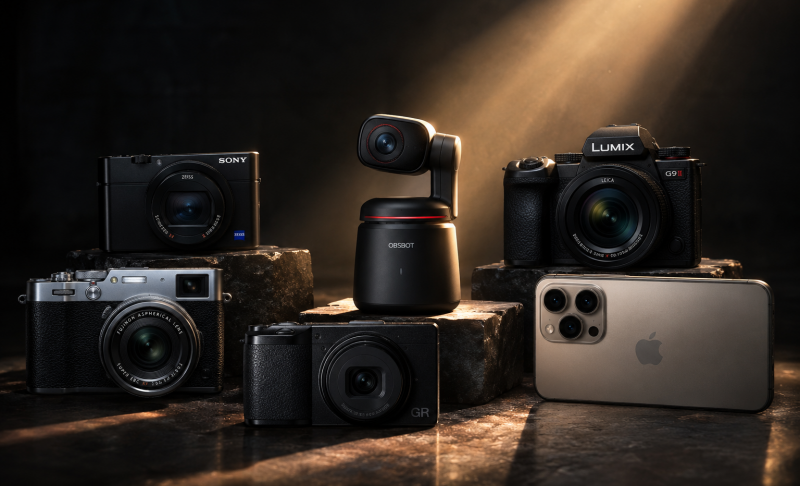
Today, cameras have become highly automated. Autofocus, digital stabilization, high-resolution sensors, intelligent tracking and network connectivity can handle tasks that once required considerable manual control.
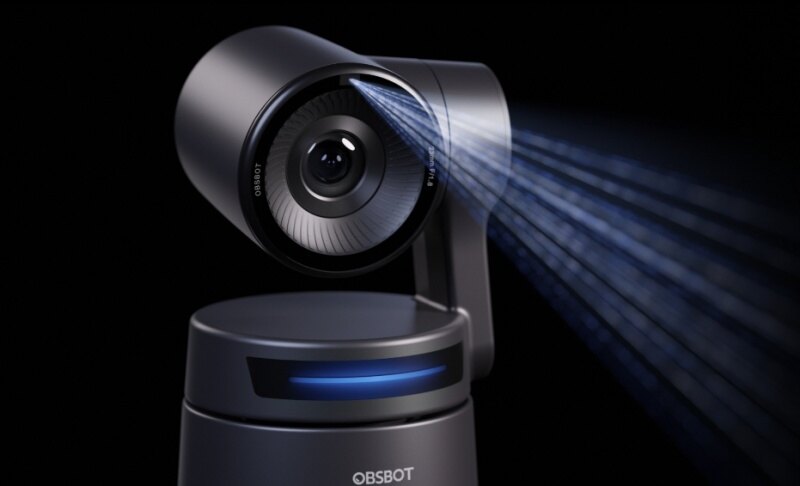
For live production, modern cameras can go considerably beyond simply recording an image. The OBSBOT Tail 2 combines 4K video, AI Tracking 2.0, 12× hybrid zoom and PTZR movement for live production workflows.
The Camera Invention Timeline
It is easier to understand the history of camera invention as a sequence of optical, chemical and mechanical developments rather than one isolated invention.
| Date | Person/Technology | Milestone |
|---|---|---|
| 5th century BCE | Camera obscura principle | Early understanding of optical image projection |
| 1685 | Johann Zahn | Detailed portable camera obscura designs that made optical image projection easier to use |
| 1816 | Niépce | Early experiments using light-sensitive materials |
| 1826/1827 | Niépce | Introduction of a method for permanently recording an image. This led to the birth of the earliest surviving permanent photograph |
| 1839 | Louis Daguerre | The daguerreotype process makes photography practical. It produced a unique image on a polished, silver-plated copper sheet and made photography much more practical than Niépce's earlier process |
| 1888 | George Eastman | Kodak camera helps popularize handheld photography in the mass market. came preloaded with roll film and was designed to make picture-taking considerably easier for ordinary users. |
| 1940s | Edwin Land / Polaroid | Instant photography demonstrated and commercially introduced. The Polaroid Model 95 first went on sale in 1948 |
| 1970s–1990s | Digital imaging | Transition from film to electronic sensors |
| 21st century | Digital and smartphone cameras | Compact cameras become integrated into everyday devices |
FAQs
Did cameras exist in 1900?
Yes. Cameras were widely available by 1900, although they were very different from today's digital models. Film and photographic plates were the dominant technologies. Kodak had already introduced its simple roll-film camera in 1888, helping make photography more accessible to consumers.
Digital vs film camera
Film cameras record images chemically on photographic film, which must be processed before the final image can normally be viewed. Digital cameras, on the other hand, use electronic image sensors to convert incoming light into digital data. This makes digital photography faster to review, store, edit and share.
Who invented Kodak?
George Eastman founded the Eastman Dry Plate Company with Henry A. Strong in 1881 and later developed the Kodak system around roll film and easy-to-use cameras. Eastman introduced the Kodak camera in 1888, making cameras dramatically simpler and more accessible for everyday users.
Conclusion
In short, there is no single answer to who found the camera. From the camera obscura to Niépce's first permanent photograph and today's AI-powered cameras, photography has evolved through centuries of innovation.