RTMP vs. RTSP vs. SRT: Which Streaming Protocol Should You Use?
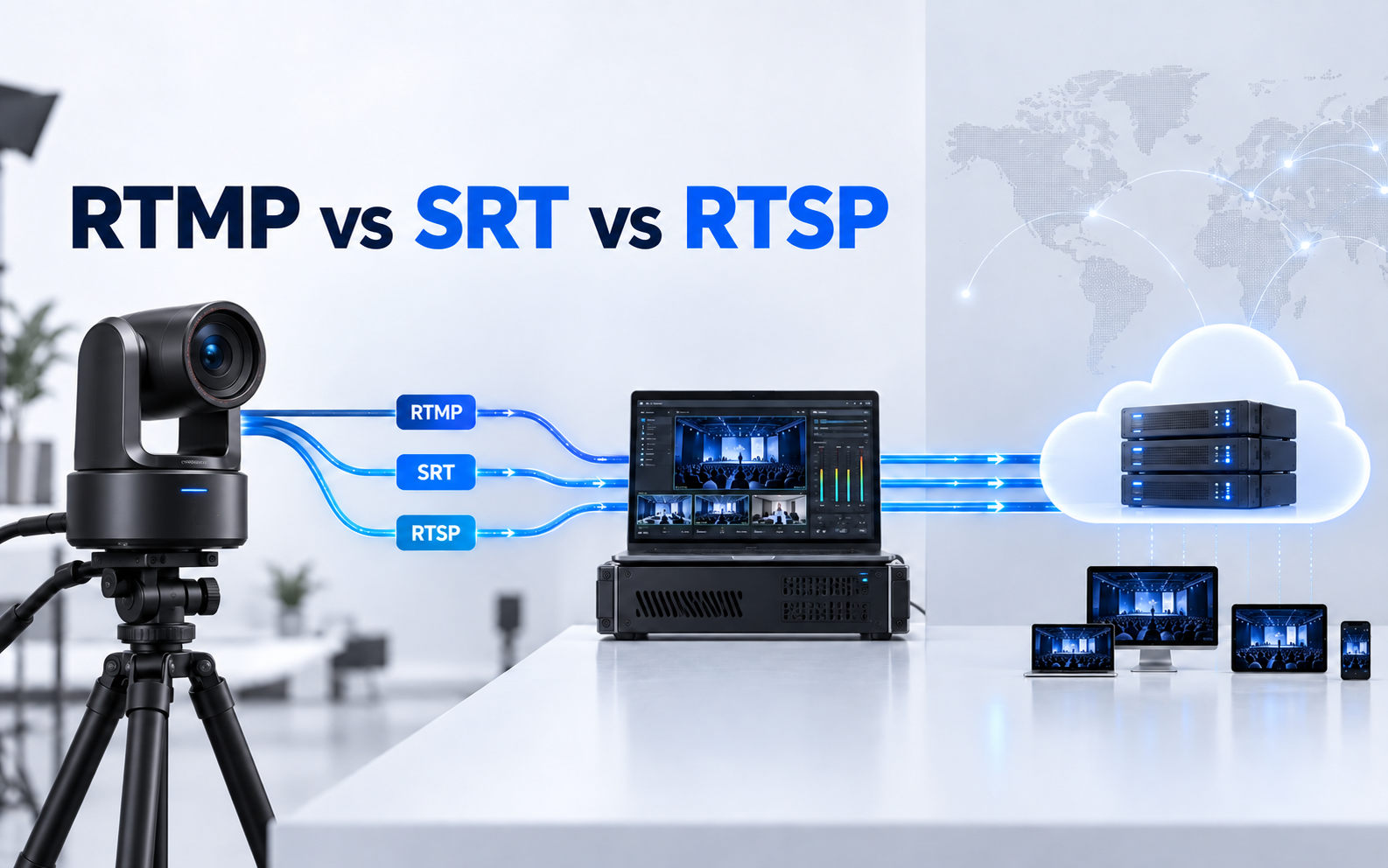
Choosing between RTMP, SRT, and RTSP depends on where your video starts, where it needs to go, and how stable the connection is. These protocols are not interchangeable versions of the same technology.
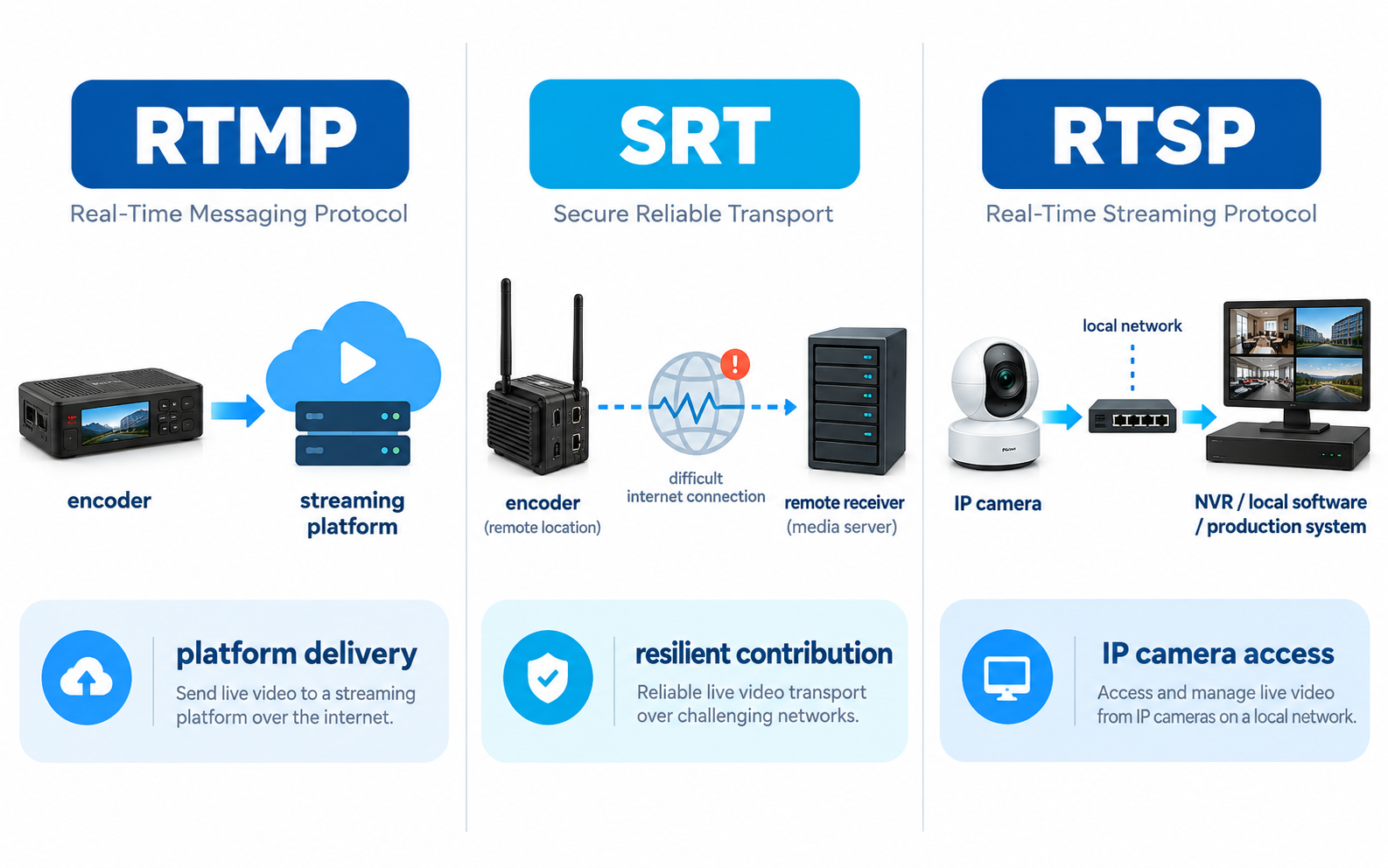
RTMP is usually the practical choice for sending video to a streaming platform. SRT is better for sending live video between production locations, while RTSP is mainly used to access video from IP cameras and local network devices.
How to Choose Between RTMP, SRT, and RTSP
The right protocol becomes easier to identify when you start with the destination instead of the protocol name.
| Protocol | Main Job | Typical Path | Choose It When |
|---|---|---|---|
| RTMP | Pushes an encoded stream to a server | Encoder or production software to YouTube, Facebook, Twitch, or a media server | You need a widely supported platform delivery method |
| SRT | Transports live video across difficult networks | Remote encoder to a compatible receiver, gateway, or media server | You need a more resilient contribution link |
| RTSP | Accesses and controls a media stream | IP camera to NVR, local software, recorder, or production system | You need to view or process a camera feed inside a network |
Choose RTMP or RTMPS for platform streaming
If your destination gives you a server URL and stream key, RTMP or RTMPS is usually the correct starting point. This is the common workflow for sending a finished program feed from OBS Studio, a hardware encoder, or a live production system to a public platform.
RTMP is practical for creator streams, webinars, gaming broadcasts, and small event productions because platform and encoder support is widespread.
Choose SRT for remote contribution
If video travels from an event venue, remote studio, or field location to another production system, SRT may be the better transport layer. It is designed for situations where packet loss, jitter, or changing bandwidth could affect the contribution feed.
SRT only works when the sending and receiving systems support it. If the final destination accepts only RTMP or RTMPS, the SRT feed will need to pass through a compatible receiver or media server before delivery.
Choose RTSP for IP camera access
If your immediate goal is to view, record, or process video from an IP camera, RTSP is usually the relevant protocol. It is common in surveillance systems, NVRs, lecture capture, remote monitoring, and production software that accepts network camera sources.
RTSP is not normally the final connection to a public streaming platform. An encoder, switcher, or media server may be required to convert the camera feed into a platform-compatible output.
What Each Protocol Actually Does
RTMP pushes video to a server
RTMP sends an encoded live feed from a camera system, computer, or hardware encoder to a streaming server. The receiving server can then distribute the stream to viewers or convert it into another delivery format.
The protocol is focused on moving a finished stream from the encoder to the server. It does not provide the camera control functions associated with an IP camera management system.
SRT protects a contribution link
SRT is built for transporting live video between compatible systems across networks that may not be perfectly stable. Its recovery and encryption features help maintain a usable contribution feed when the connection experiences packet loss or changing conditions.
That makes SRT more relevant to production transport than to a simple creator stream that goes directly from an encoder to a platform.
RTSP accesses a media session
RTSP is a control protocol used to request and manage a media stream. In practice, it is often associated with IP cameras and local network video devices.
An application may use an RTSP URL to pull a camera feed for monitoring, recording, or production. The protocol describes how the device and receiving software manage the stream; it does not automatically determine how that stream reaches public viewers.
How These Protocols Work Together
Large or distributed productions may use all three protocols because each one handles a different part of the signal path.
- Camera access: An IP camera sends an RTSP feed to a switcher, recorder, or production application.
- Remote contribution: The production system sends the program feed over SRT to a remote control room or media server.
- Platform delivery: The receiving system converts the program feed to RTMP or RTMPS for YouTube, Facebook, Twitch, or another platform.
This structure separates the camera-access layer, the contribution layer, and the public distribution layer. It also makes troubleshooting easier because every connection has a defined purpose.
Check the complete signal path before choosing equipment. A camera may output RTSP, an encoder may accept SRT, and a streaming platform may require RTMP. Compatibility at one point does not guarantee that the entire workflow will work.
Choosing a Camera for RTMP, SRT, and RTSP Workflows
The streaming protocol determines how video travels, while the camera determines how the source looks and behaves before it reaches the encoder or production system. Choose the camera based on the scene first, then confirm that the rest of the signal path supports the required protocol.
A fixed IP camera may be enough for an RTSP monitoring workflow. A remotely controlled PTZR camera becomes more useful when the stream includes a moving presenter, stage performance, product demonstration, or event space that needs continuous reframing.
OBSBOT Tail 2 fits this type of live production setup as a camera source for a compatible encoder, switcher, or media server. It can support the capture and framing side of the workflow, while the encoder or receiving system determines whether the final connection uses RTMP, SRT, or RTSP.
- Moving subject coverage: PTZR control helps the operator follow a presenter or stage area without physically repositioning the camera.
- Solo production: AI tracking helps maintain the shot when one person is presenting while also monitoring the stream or managing production controls.
- Flexible framing: 4K capture leaves more detail for wide shots, tighter crops, and alternate layouts across different outputs.
- Remote operation: Camera adjustments can be made from the production position, which is useful when the camera is placed on a stage or across an event space.
- Multi-camera setups: Tail 2 can serve as one controlled angle in a larger studio, event, performance, or product demonstration workflow.
Important limitation: Tail 2 is a camera source, not an RTMP, SRT, or RTSP converter. The encoder, media server, switcher, or streaming destination must support the protocol required for that connection.
FAQs About RTMP, SRT, and RTSP
Is RTSP still relevant today?
Yes. RTSP remains useful for accessing video from IP cameras, NVRs, monitoring systems, and local production networks. It is less common as the final delivery method for public streaming platforms.
Is RTMP still used?
Yes. RTMP and RTMPS remain widely used between encoders and live-streaming platforms. The platform may convert the incoming stream into another format for viewer playback, but the creator-side workflow can still use RTMP.
What are the disadvantages of RTSP?
RTSP can require more network and software configuration than a direct platform workflow. Public platforms may not accept it directly, so an encoder or media server may be needed before the feed can reach viewers.
Are ONVIF and RTSP the same?
No. RTSP handles media streaming and session control, while ONVIF is a broader interoperability standard for discovering, configuring, and controlling compatible IP devices. A camera may support both, but they serve different purposes.
Can SRT replace RTMP?
SRT can replace RTMP for a contribution link when both endpoints support SRT. It is not a universal replacement for platform delivery, so an SRT receiver or gateway may still need to output RTMP or RTMPS.
Conclusion
Use RTMP or RTMPS when sending a finished stream to a platform. Choose SRT when transporting live video between production systems across a difficult network. Use RTSP when accessing or processing video from an IP camera or local network source. In a larger production, the most practical workflow may use all three at different points.